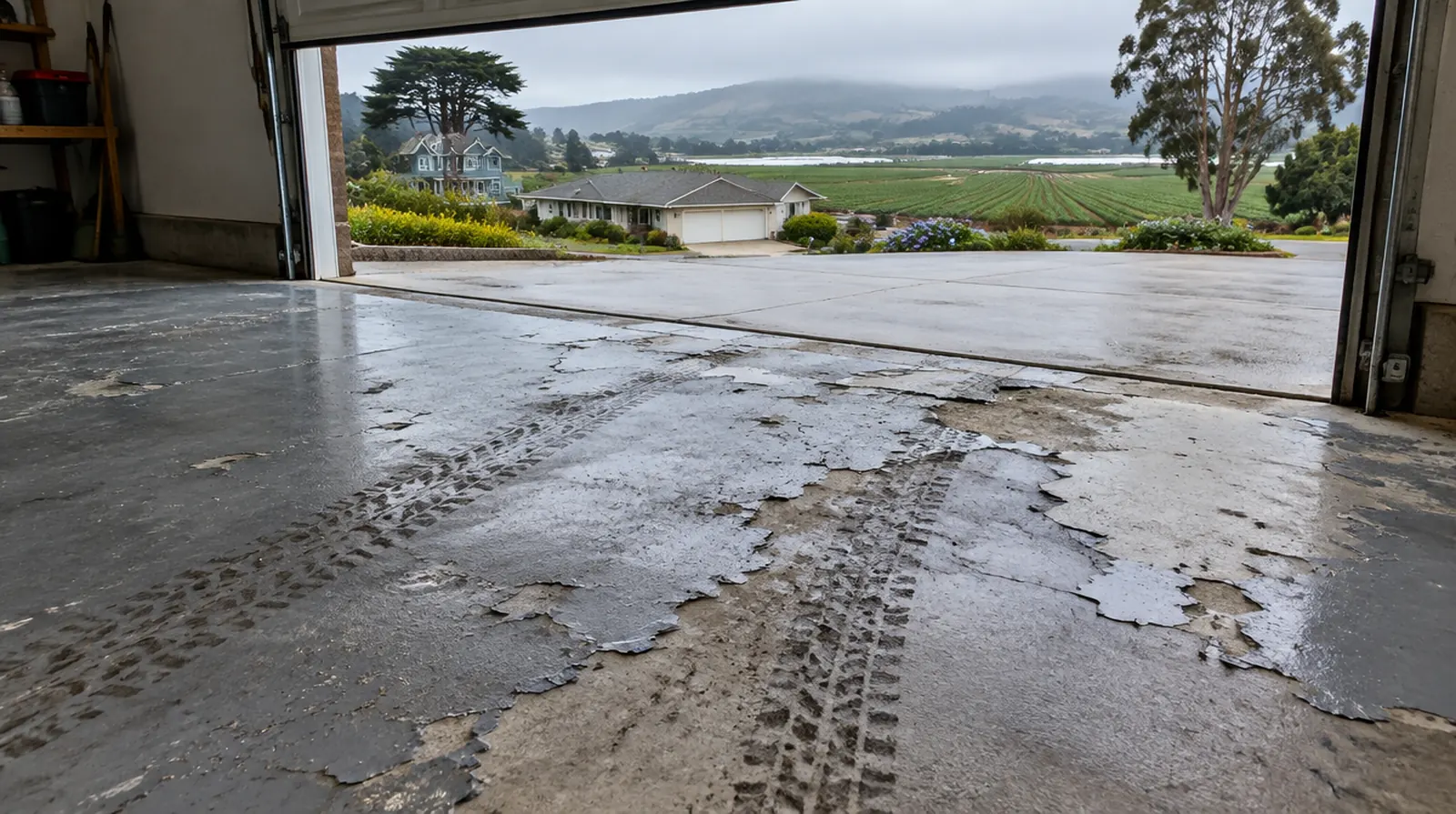
Why floors fail
Coatings fail for a handful of reasons. The most common here is moisture: vapor rising through the slab pushes the coating up in blisters that eventually crack and peel. Next is poor prep, usually a floor that was acid-etched or not prepared at all, leaving a weak bond. Hot tire pickup, where warm tires soften thin coatings and pull them off, is another. UV yellowing, chemical damage and impact chips round out the list.
Understanding the cause matters, because patching without fixing the reason just means another failure.
Our repair approach
Diagnosis
We inspect the damage, test moisture, check adhesion in sound areas and ask about the floor's history. This tells us whether a spot repair will hold or whether the whole floor needs to come up.
Spot repairs
When most of the coating is well bonded, we grind out failed areas past the edges of the damage, feather the transitions, fill and recoat. Matching flake blends exactly is not always possible on older floors, so we may recommend a fresh topcoat over the whole floor for a uniform look.
Full removal
When adhesion is poor across the floor, we grind everything off, test again and rebuild with a proper system, including vapor-blocking primer if readings call for it.
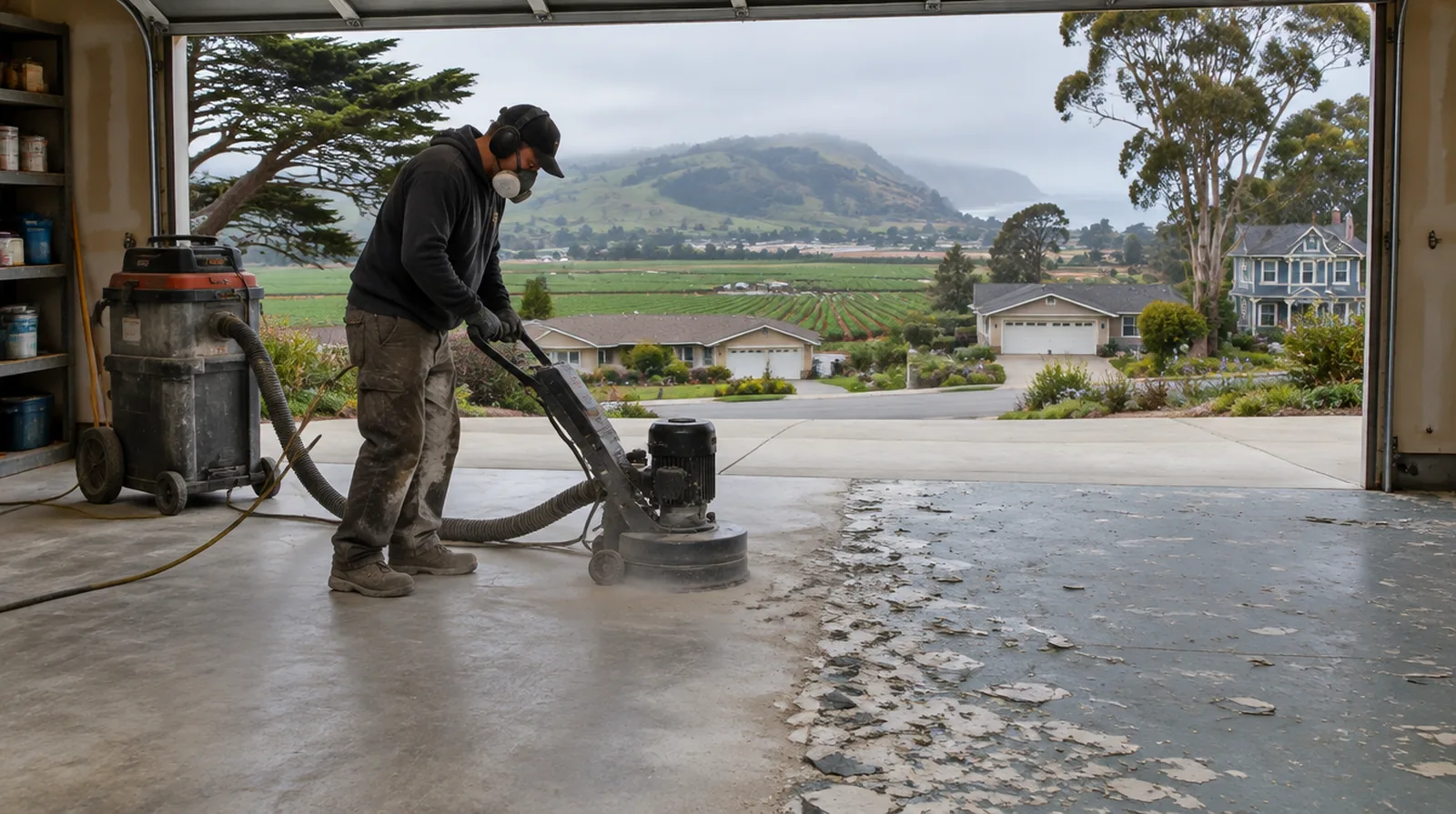
Common problems we see
Blisters along the back wall of garages built on low ground. Peeling tire tracks on kit coatings. Yellowed, chalky epoxy near the garage door. Chips around the threshold where winter water sits. Discolored spots where fertilizer, pool chemicals or battery acid were stored. Each has its own fix, and we explain it plainly.
Crack repair
Hairline cracks from settling or old quakes can be filled and blended. Moving cracks and control joints get flexible fillers so they do not break the coating again. Wide or lifted cracks may need grinding level before any coating work.
Repair or replace?
We give both options side by side, with cost and expected lifespan. A partial fix may be smart for a home going on the market soon. A full replacement usually makes sense for owners planning to stay.
Questions
Can you match my existing floor?
We try, but older coatings fade, so a uniform topcoat is often the best finish.
Will the blisters come back?
Not if the moisture problem is treated during the repair.
How long do repairs take?
Spot repairs are often one visit; full replacements take one to three days.
Have a failing floor? Send photos and book an inspection.
Commercial repairs
Shops, coolers and kitchens with damaged sections around drains, under equipment or along forklift lanes can be repaired overnight with fast-setting materials, keeping work moving the next morning.
Repairs after plumbing work
When plumbers cut a trench through a garage slab, the patch and the coating around it need to be rebuilt. We grind the patch flush, prime it and blend the new coating into the existing floor.
Flood-damaged floors
Silt and standing water often loosen old coatings. After the slab dries, we test and decide whether to repair or rebuild.
Fixing hot tire pickup
When warm tires lift a coating, it is a sign the original layer was too thin or poorly bonded. We remove the weak material in the tire lanes and rebuild with a properly ground, thicker system, so the problem does not return.
Yellowed floors
Older epoxy without a UV-stable top turns amber near the door. We sand it and apply a polyaspartic topcoat, restoring a consistent color across the floor.
Get a repair estimate
Call (000) 000-0000 for a free estimate.