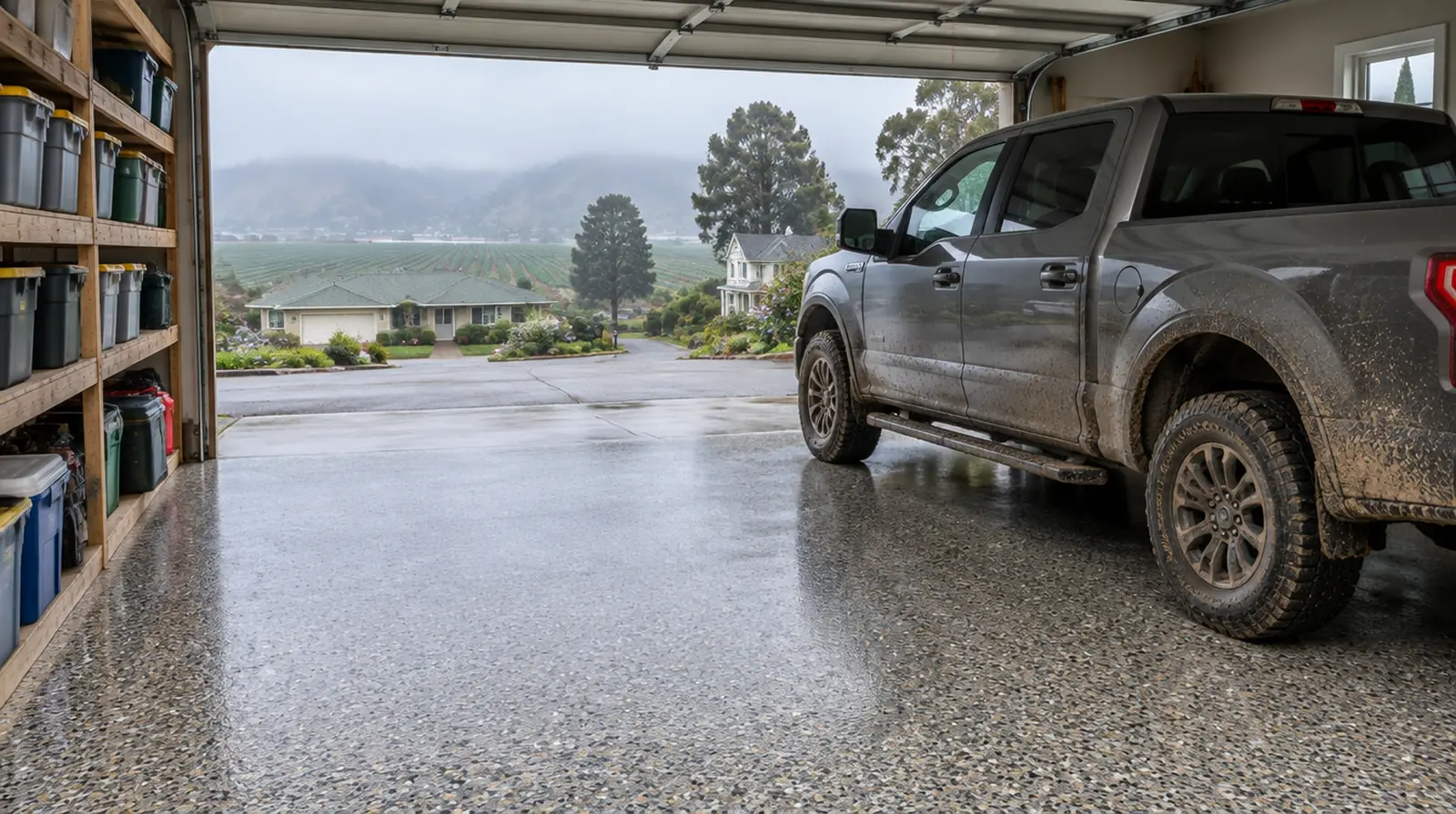
The practical floor for a muddy town
If one floor type fits life in a farm valley, it is a flake floor. Between rainy winters, dusty summers and work boots that come home from the fields, garages here get dirty fast. A solid gloss floor shows every footprint. A full broadcast flake floor, with thousands of multicolored chips locked into the coating, breaks up the surface visually so a layer of dust or a few muddy prints barely register. You clean on your own schedule, not because the floor is shouting at you.
The chips also add texture. Under a clear topcoat they create a subtle grip that helps on damp mornings, and they make the floor more forgiving of small scratches from tools and bike pedals.
How we build it
Prep
We test moisture, diamond grind the slab and repair cracks and chipped edges. On damp slabs we prime first with a vapor-blocking epoxy.
Base and broadcast
A colored base coat is rolled out in sections. While it is wet, we throw flakes by hand until the floor is covered edge to edge. Full coverage builds thickness and gives the most uniform look.
Scrape and seal
Once the base cures, we scrape off loose and standing chips, vacuum thoroughly and roll on a clear topcoat. Polyaspartic is our usual top for garages because it resists yellowing near the door and cures quickly.
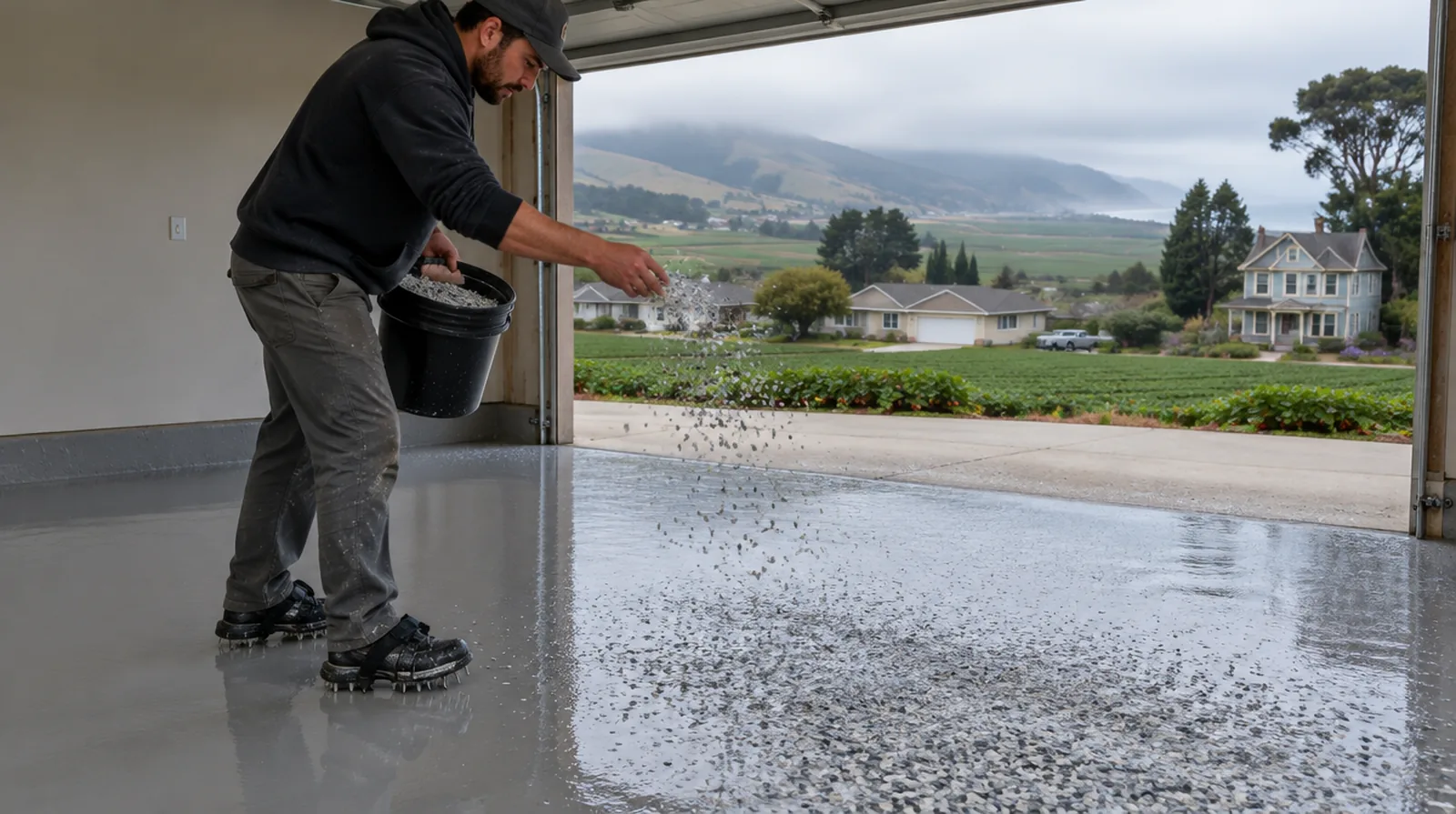
Choosing a blend
Gray and black blends with white accents look clean and modern. Tan, brown and cream blends suit older homes and hide the brown valley soil especially well. Darker blends with some blue or green flecks suit shops and man caves. We bring sample boards to your garage so you can see them in your own light, which here is often soft and gray.
Chip size and texture
Standard quarter-inch flakes give a classic speckled look. Smaller chips feel finer and more granite-like. Larger chips make a bolder statement. Chip size also affects texture: a thin topcoat over large chips feels grippier, while a heavier top smooths things out. We help you balance looks and traction.
Cove bases
A cove base carries the flake a few inches up the wall, rounding the corner between floor and wall. It hides the joint where dirt and water collect and makes hosing out the garage much easier. Families who wash muddy gear in the garage often love this detail.
Questions
Is flake stronger than solid epoxy?
A full broadcast adds thickness and hides wear, so for garages it usually outlasts a solid coat.
Is it hard to clean?
No. Sweep, then mop or squeegee. The topcoat seals the chips so dirt sits on the surface.
Can you do partial broadcast?
Yes, for a lighter speckle, though full coverage is more durable.
Want to see the blends? Schedule a free estimate.
Flake beyond the garage
Flake systems work in laundry rooms, mudrooms, covered patios, basements and small business spaces. A back mudroom where boots come off after a day in the rows is a perfect spot: it handles water, hides dirt and connects nicely to a coated garage.
Rentals and multi-family
Landlords with duplexes and small apartment buildings use flake floors in shared laundry rooms and storage areas because they hold up to many users and need little upkeep between tenants.
Flake floors are also among the most budget-friendly decorative options, giving a custom look without the labor of a metallic pour.
Get a flake floor estimate
Call (000) 000-0000 for a free estimate.